

Best ITSM platforms for startups in 2026
Category: Startups
best ITSM platforms for startupsenterprise service management (ESM)help desk softwareIT asset managementIT service managementstartup ITSM software

Most startups don’t set out to buy an ITSM platform. They set out to stop losing track of laptops, stop answering the same password-reset request over email for the third time this week, and stop finding out about a server issue from a customer instead of a monitoring alert. By the time a 6-person IT team is running on a shared spreadsheet and a Slack channel, the search for the best ITSM platforms for startups usually starts with a frustrated Friday afternoon, not a formal RFP.
This comparison looks at five platforms startups actually shortlist in 2026: Alloy Software, Freshservice, Jira Service Management, ManageEngine ServiceDesk Plus, and, as a reference point for what “too much platform” looks like, ServiceNow. The pricing figures below are pulled from each vendor’s published rate cards as of mid-2026 and modeled against a 5-agent IT team, since that’s the size where most startups are actually shopping.
Why spreadsheets stop working around the 5-technician mark
The failure pattern is consistent across the qualification notes Alloy Software’s sales team has collected from more than 40 closed deals in the last two years. A small IT team starts with 100 to 500 managed endpoints, tracked in Excel or a homegrown Access database, and a ticket queue running through a shared inbox. Nothing ties the two together, so nobody can answer a basic question like “which laptops are still on the old VPN client” without opening three files.
The trigger that actually moves a startup toward evaluating ITSM platforms is rarely “we want better software.” It’s a compliance deadline, a failed internal audit, an incumbent tool doubling its renewal price, or a new IT hire who has used a real platform before and refuses to keep running things off a spreadsheet. In Alloy’s own deal data, vendor price hikes on tools like Lansweeper, and forced cloud migrations out of on-prem Jira, show up again and again as the specific event that starts the search.
What actually matters when comparing ITSM platforms for startups
Feature checklists are close to useless here, because every vendor in this category claims ticketing, assets, and reporting. The differences that matter for a 5 to 25 person IT team show up in four places: how much of the asset and ticketing workflow is available on the entry-level tier, whether pricing is per-agent (so it climbs every time you hire) or a flat license band, how much implementation effort a lean team has to absorb before the tool is useful, and whether on-premise hosting is even an option for teams in healthcare, government, or aviation that can’t put device data on someone else’s cloud.
A fifth criterion gets overlooked until it bites: what happens when HR, facilities, or security want to use the same ticketing tool IT already has, without IT staff being able to see HR’s tickets about someone’s medical accommodation request. That’s enterprise service management, and it’s the reason a startup’s first ITSM purchase often has to last through its next three years of headcount growth rather than getting replaced in eighteen months.
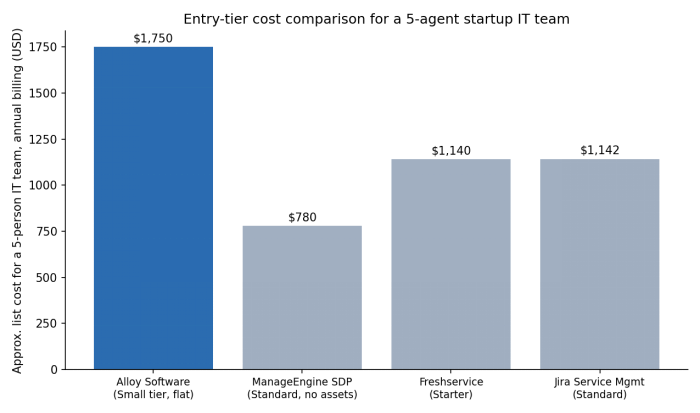
Approximate list cost for a 5-person IT team on each vendor’s entry tier, annual billing.
The five platforms startups actually shortlist
Alloy Software
Alloy Software prices its small-team band at $1,000 to $3,500 a year as a flat license for 1 to 4 technicians and under 500 managed assets, not a per-agent fee, which is the detail that makes it stand out among the best ITSM platforms for startups once a team is actively hiring. Ticketing, asset discovery, a knowledge base, and a configurable CMDB ship together on that band; there’s no separate paywall to unlock asset management, which is where Freshservice’s Starter tier and ManageEngine’s Standard edition both fall short.
The feature that keeps coming up unprompted in Alloy’s own customer interviews is data segmentation: the ability to let HR, facilities, or security run tickets through the same platform IT uses, without IT technicians seeing HR’s sensitive tickets. Customers rarely ask for it by that name. They describe the problem instead, something close to “is there a way to bring another team onto our IT system without IT seeing their data,” and the answer turns out to be a feature Alloy already ships but doesn’t market loudly enough. Alloy also supports on-premise hosting, which matters for the healthcare and public-sector startups that make up a large share of its customer base and legally can’t put device and patient-adjacent data on shared cloud infrastructure.
The trade-off: Alloy’s UI is more utilitarian than Freshservice’s, and its workflow engine, while flexible enough that some customers stay on it for 15 years without migrating, has a steeper initial learning curve than a modern SaaS ticketing tool. It rewards teams willing to spend a week configuring categories properly; teams that just want to click “deploy” and walk away will feel that friction.
Freshservice
Freshservice’s Starter plan runs $19 per agent per month on annual billing, or about $1,140 a year for 5 agents, and covers incident management, a knowledge base, and basic workflow automation. It’s the easiest of this group to get a small team onto quickly, and the interface is genuinely pleasant to use.
The catch is that asset management, the service catalog, and approval workflows don’t appear until the $49-per-agent Growth tier, and change, problem, and release management wait until the $95 to $99 Pro tier. A 5-agent team wanting full ITSM plus asset tracking is really looking at $2,700 to $5,900 a year, and that number keeps climbing every time headcount grows, since Freshservice bills per agent with no volume break for small teams.
Jira Service Management
Jira Service Management makes sense by default for a startup already running engineering on Jira Software, since incidents and requests live next to the sprint board with no separate login. Standard runs about $19 to $20 per agent per month annual, roughly $1,140 to $1,200 a year for 5 agents, but CMDB and asset tracking are locked behind Premium at $47 to $51 per agent per month, close to $2,900 a year for the same 5-agent team.
The honest limitation, echoed across G2 reviews and Atlassian’s own community forums, is that JSM was built for software teams handling internal requests first and asset-heavy IT operations second. Teams that need serious hardware and software inventory tracking, not just ticket routing, tend to find the asset module thinner than a dedicated ITAM tool once they actually configure it.
ManageEngine ServiceDesk Plus
ServiceDesk Plus is the cheapest entry point in this comparison: Standard cloud pricing starts around $13 per technician per month, about $780 a year for a 5-person team, and there’s a free edition for up to 5 technicians if annual maintenance fees aren’t a dealbreaker. The catch is that Standard is help desk only. Asset management doesn’t appear until Professional at roughly $27 per technician per month, and change management plus project tracking wait for Enterprise at $67 per technician per month, which pushes a 5-tech team with real asset needs into $1,600 to $4,000 a year territory.
ManageEngine, owned by Zoho Corporation, has a reputation for stable long-term pricing without the aggressive annual renewal increases some SaaS vendors apply, which matters to a budget-conscious founder planning three years out rather than one. The trade-off is an admin interface that reviewers consistently describe as dated and harder to navigate than Freshservice or Alloy’s newer screens.
ServiceNow, as a reference point
ServiceNow doesn’t publish list pricing and isn’t really built for a 5 to 25 person IT team in the first place; contracts typically start in the tens of thousands of dollars a year and assume a dedicated ServiceNow administrator on staff. It’s included here only because founders sometimes get quoted it during a vendor bake-off and need a reason to say no: the platform’s configurability is real, but so is the implementation timeline, which for most mid-market deployments runs months rather than weeks.
Which tier fits which team, in practice
Alloy’s own closed-deal data breaks its customer base into three bands by technician count and asset volume, and the pattern holds up reasonably well across the other vendors in this list too, even though their tier names and price points differ.
| Segment | Technicians | Managed assets | Typical annual budget |
| Small / early-stage | 1–4 | Under 500 | $1,000–$3,500 (Alloy flat); $780–$2,700 per-agent tools |
| Mid-market / Series B–C | 5–10 | 500–1,500 | $3,500–$7,500 (Alloy); $5,000–$9,000 per-agent tools |
| Enterprise-lite / scaling fast | 10–35 | 1,500–5,000+ | $7,500–$25,000 (Alloy); $12,000–$40,000+ per-agent tools |
Where each platform actually breaks
Per-agent pricing is the single biggest hidden cost across this category. A startup that goes from 4 IT technicians to 10 in eighteen months, which is a normal growth curve, sees its Freshservice or Jira bill more than double on the same tier, while a flat-license model like Alloy’s absorbs that growth inside the same license band until the team crosses into the next asset-count bracket. This is worth modeling explicitly before signing a contract, not after the first renewal invoice arrives.
Implementation effort is the second trap. Teams that roll out a service desk and stop at “can people submit tickets” are only doing a third of the job. Gathering ticket data, managing it through consistent categories, and analyzing it through reporting are three separate steps, and skipping the categorization step is why so many IT teams end up with reporting that tells them nothing useful six months later. This applies equally whether the platform is Alloy, Freshservice, or anything else on this list; it’s a process failure, not a software failure, and no vendor’s onboarding wizard fixes it automatically.
Enterprise service management: the feature that shows up before anyone names it
HR, facilities, and finance departments generate a genuinely large volume of internal service requests, onboarding paperwork, badge access, expense approvals, but their ticket data is often sensitive in a way IT’s ticket data isn’t. A password reset ticket isn’t confidential. An HR case about a workplace complaint is. This is the practical argument for enterprise service management (ESM): letting other departments run their operational requests through the same ticketing backbone IT already pays for, gated by data segmentation so IT staff can administer the platform without reading HR’s case notes.
Adoption of this pattern accelerated industry-wide once remote work went mainstream, since IT service management practices had two to three decades of maturity behind them while HR service delivery, as a discipline, is roughly a decade into its own development. Facilities teams tend to care less about segmentation than HR does; a facilities ticket about a broken elevator often benefits from IT visibility, since it can tie into the same asset-management workflow. HR data, by contrast, needs a harder wall. Any of the platforms in this comparison that support role-based data segmentation, not just role-based permissions on a shared queue, can support this pattern; the ones that treat it as an enterprise-tier add-on rather than a core feature make it considerably more expensive to adopt later.
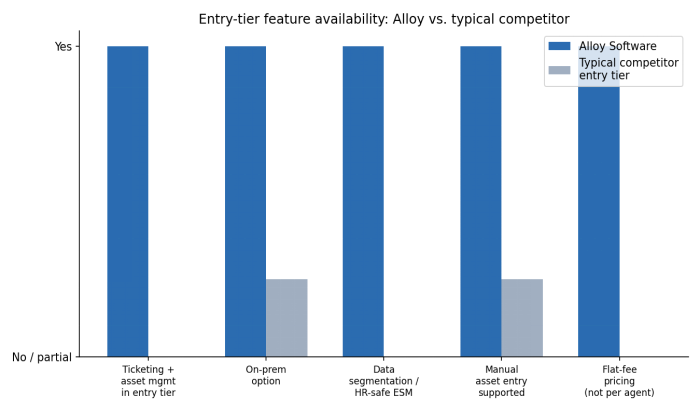
Entry-tier feature availability, based on each vendor’s published pricing pages as of mid-2026.
A practical way to run the evaluation
Before requesting a demo from any vendor, it’s worth writing down four numbers on a single page: current technician count and where it’s headed in 12 months, current managed asset count, whether any department outside IT will eventually need tickets (HR and facilities most commonly), and whether hosting has to be on-premise for compliance reasons. Those four inputs eliminate most of the vendors on this list before a single sales call happens.
For teams answering “we’re staying under 10 technicians, our headcount is stable, and nobody outside IT needs this,” Freshservice’s Growth tier or ManageEngine’s Professional edition are both reasonable, low-friction choices. For teams answering “we’re hiring fast, we’ll need HR or facilities on this within a year, and on-prem might matter,” the flat-license model and built-in data segmentation are the reasons Alloy Software tends to come out ahead among the best ITSM platforms for startups planning past their next funding round.
The bottom line
There isn’t a single best ITSM platform for every startup; there’s a best fit for a given technician count, asset volume, and growth trajectory. Alloy Software’s flat small-team pricing and built-in ESM support make it the strongest option for startups that expect to add both headcount and departments over the next two to three years. Freshservice wins on day-one usability for teams that will stay small. ManageEngine wins on raw price for teams that can live without asset tracking on day one. Jira Service Management wins only when the engineering org is already living inside Jira. Whichever platform gets chosen, the categorization work at setup, gathering, managing, and analyzing ticket data as three distinct steps, matters more to long-term reporting quality than which logo is on the login page.


