

How cryptocurrencies help startups reduce costs
Category: Startups
cost reductioncross-border paymentsCrypto for startupsfintech paymentsstablecoins

A $10,000 supplier payment sent over SWIFT loses somewhere between $200 and $700 to fees, FX spread and intermediary deductions before it clears – and it clears in one to five business days, not on weekends. The same amount sent as USDC on Solana costs a fraction of a cent in network fees, plus on- and off-ramp charges, and confirms in under a minute. That gap is the whole reason a growing number of early-stage companies route money through crypto rails.
For a seed-stage startup burning $80,000 a month, payment friction is not a rounding error. Cut 3% off international vendor and contractor spend and you recover roughly a month of runway across a year. This is where cryptocurrencies help startups reduce costs in a way that shows up on the P&L: fewer intermediaries, near-zero settlement fees, and money that moves at any hour.
Where a startup’s money actually leaks
Most cost leaks in a young company’s payment stack sit in four places: cross-border transfers, contractor payroll, card processing, and idle cash. Traditional wire transfers run 2–7% once FX spreads and correspondent-bank charges are counted (BVNK, 2025). Card networks take 2–3% and add chargeback risk. World Bank data put the global average cost of sending a $200 remittance at 6.49% in Q1 2025, and 7.16% for non-digital channels.
Stablecoins attack the same flows from a different architecture. A Keyrock report cited in August 2025 found that a $200 cross-border transfer costs about 12.66% through banks and 5.35% through money-transfer operators, but under 1% on stablecoin platforms. EY-Parthenon’s 2025 survey found 41% of stablecoin users reporting at least 10% savings on B2B cross-border payments, with mid-market firms in the 10–20% range.
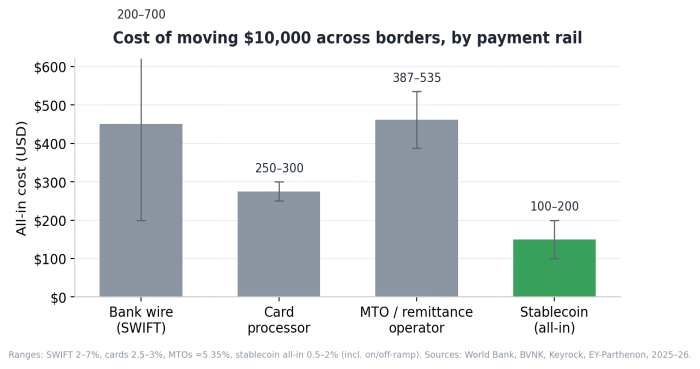
Figure 1. All-in cost of moving $10,000 across borders. Stablecoin figures include on/off-ramp fees.
Cross-border pay and remote payroll: the biggest lever
The clearest case for crypto in a startup is paying people and suppliers in other countries. A design contractor in Buenos Aires, a dev shop in Lahore, a fulfilment partner in Manila – each traditional payout carries a fixed fee that barely moves with transaction size. FXC Intelligence’s 2025 data pegs the average emerging-market cross-border fee at $28–$52 per transaction. A stablecoin transfer to the same wallet typically costs under $1.
Speed compounds the saving. Settlement in minutes instead of three to five days releases working capital and removes the unhedged FX exposure that hurts thin-margin firms – a Brazilian exporter quoting in reais can watch a 15% swing erode the deal before a wire clears. That said, the on-chain leg is only part of the bill. On-ramp fees run 0.5–2%, off-ramp 0.5–3%, and local cash-out has to be liquid and compliant for the corridor to actually beat a bank.
The table below compares the main rails a founder is likely to choose between.
| Rail | Settlement time | All-in cost* | Practical limits for a startup |
| Bank wire (SWIFT) | 1–5 business days | 2–7% | Correspondent chains, cut-off times, opaque FX spread, weekend gaps |
| Card processor | 1–3 days | 2–3% + chargebacks | Chargeback exposure, regional decline rates, rolling reserves |
| MTO / remittance | Minutes–days | ≈5.35% avg ($200) | Corridor coverage, KYC per payout, payout caps |
| Stablecoin (USDC/USDT) | Seconds–minutes, 24/7 | 0.5–2% all-in | On/off-ramp fees, local cash-out liquidity, accounting overhead |
*All-in cost includes transfer fees, FX spread and intermediary charges. Ranges from World Bank, BVNK, Keyrock and EY-Parthenon, 2025–26.
Chargebacks, card fees and the cost of network choice
For startups selling digital goods or subscriptions, card processing is a double cost: the 2–3% interchange plus the operational drag of disputes and rolling reserves. Accepting crypto directly removes the chargeback vector entirely – on-chain payments are final – and drops the marginal fee close to the network cost. Which network you pick then decides whether that saving is real.
What you actually pay per transaction
Ethereum mainnet averaged about $0.44 per transaction in August 2025 and can spike above $8 during heavy on-chain events, which makes it a poor fit for high-frequency, low-ticket payments. Ethereum layer-2s fell roughly 90% after the 2024 Dencun upgrade. Solana sits near $0.00025 per transaction with a fixed base fee that barely moves under load, which is why teams running many small payments – in-game economies, micro-payouts, streaming settlements – default to it.
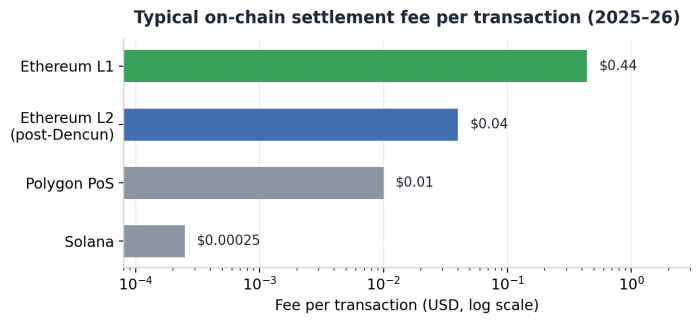
Figure 2. Typical on-chain settlement fee per transaction. Log scale; values from 2025–26 network data.
The lesson from running payments across chains: pick the network for the payment pattern, not the brand. High-value, low-volume settlement can live on Ethereum L1 where finality guarantees justify the fee. Thousands of small payouts belong on Solana or an L2. Mixing the two – treasury on Ethereum, operational payouts on Solana – is common and sensible.
Idle cash and vendor billing
Money a startup is not spending this week still costs it something in opportunity terms. A traditional business current account pays close to nothing. Parking part of the treasury in tokenised T-bills or audited yield products has offered 3–5% variable returns, which for a company holding $500,000 is $15,000–$25,000 a year that would otherwise sit flat. This is treasury management, not speculation – and it carries smart-contract and counterparty risk that a founder should size before committing operating cash.
The same logic reaches recurring infrastructure bills. Cloud, proxies, monitoring, anti-detect tooling and data pipelines are paid every month, and each card renewal quietly adds an FX conversion and a processor markup for a team billing in one currency and buying in another. Paying vendors that accept crypto strips both out. Proxys.io, for example, prices individual IPv6 proxies from $0.13 per item per month and accepts crypto payment, so an arbitrage or data-collection team scaling to hundreds of endpoints settles the whole bill on-chain without a card FX hit on every cycle. Full current pricing is published per proxy type.
That matters most for exactly the workloads that need many IPs – multi-account SMM, marketplace research, price monitoring, review management. For those teams the proxy line is a real monthly cost centre, and removing the payment markup on it is a small but repeatable win.
Where crypto does not cut costs
Crypto is not free money, and pretending otherwise is how startups get burned. On/off-ramp fees and fiat FX at both legs often dominate the all-in cost, so a poorly chosen corridor can end up no cheaper than a bank. Most stablecoins are USD-referenced (about 99%, per a 2025 Riksbank staff memo), which means non-USD businesses still eat conversion spread twice.
Accounting and compliance add overhead that a spreadsheet founder underestimates: every on-chain transaction is a taxable event to track, wallets need controls, and holding volatile assets on the balance sheet invites impairment. Keeping value in stablecoins rather than BTC or ETH avoids the price-swing problem but not the reporting one. Treat the savings as net of a real bookkeeping cost, not gross.
A practical order of adoption
A founder does not need to convert the whole finance stack at once. The sequence that tends to work, lowest risk first:
- Start with one corridor. Move a single recurring international payout – one contractor or one supplier – to USDC and measure the true all-in cost against the old wire for two months.
- Pick the network for the pattern. Solana or an L2 for frequent small payouts; Ethereum L1 only where finality is worth the fee.
- Pay crypto-friendly vendors directly. Shift infrastructure bills that already accept crypto to remove the per-renewal FX and card markup.
- Add treasury last. Only once payments are stable, and only with capital you can leave untouched for the yield horizon.
- Instrument the books from day one. Wire wallet activity into accounting before volume grows, not after.
Run that way and the numbers are concrete rather than aspirational: on $1M of annual cross-border spend, a shift from a 4% blended bank cost to a 1% all-in stablecoin cost keeps roughly $30,000 in the company. For a team that also removes card FX on infrastructure and puts idle cash to work, the combined effect is a measurable extension of runway – which, at the seed stage, is the only currency that ultimately counts.
